
Insights

From the research desk

Market analysis and engineering deep-dives on the category we believe will define residential AV in 2026 and beyond.

Research  /  Insights
Market Analysis

Why 2026 looks exactly like 2021 did for shades

Five years ago, motorized shades were a custom-only luxury most homeowners had never considered. Today they're a baseline expectation in any high-end project. That transition didn't happen because shades suddenly got invented — they'd existed for decades. It happened because four conditions lined up at once. We've watched the same four conditions reappear before every category breakout since, and right now they're all present in a corner of the industry almost nobody is watching: outdoor audio.

The pattern beneath the waves

When we map the last decade of residential technology adoption, the waves are unmistakable. Motorized shades reached the mainstream around 2021. Tunable, layered architectural lighting crossed over in 2024. Whole-home power and battery storage scaled through 2025. Each looked inevitable in hindsight and improbable beforehand.

What they shared wasn't a technology. It was a setup: real demand that existing products couldn't satisfy, a visible-intrusion problem that designers hated, an engineering breakthrough that quietly removed the trade-off, and a sales narrative that practically told itself once a client experienced it.

Categories don't break out when the technology is invented. They break out when the last objection disappears.

Signal one: the demand was never the problem

Outdoor living has been one of the fastest-growing areas of residential investment for a decade — outdoor kitchens, fireplaces, pergolas, and especially landscape lighting. Yet audio consistently lags every other element in attach rate. It isn't because people don't want music in the yard. In our Q4 2025 survey, 73% of homeowners who declined outdoor audio cited the same reason: they didn't want to look at the speakers. The demand was always there. The available products forced a choice between sound and sightlines.

Signal two: the engineering finally caught up

The legacy rock speaker deserved its reputation. A single full-range driver in a hollow plastic shell, no real low end, no tuning, no aiming. It was a novelty, and the market treated it like one. But none of the things that made it bad were laws of physics — they were the result of nobody investing in the category.

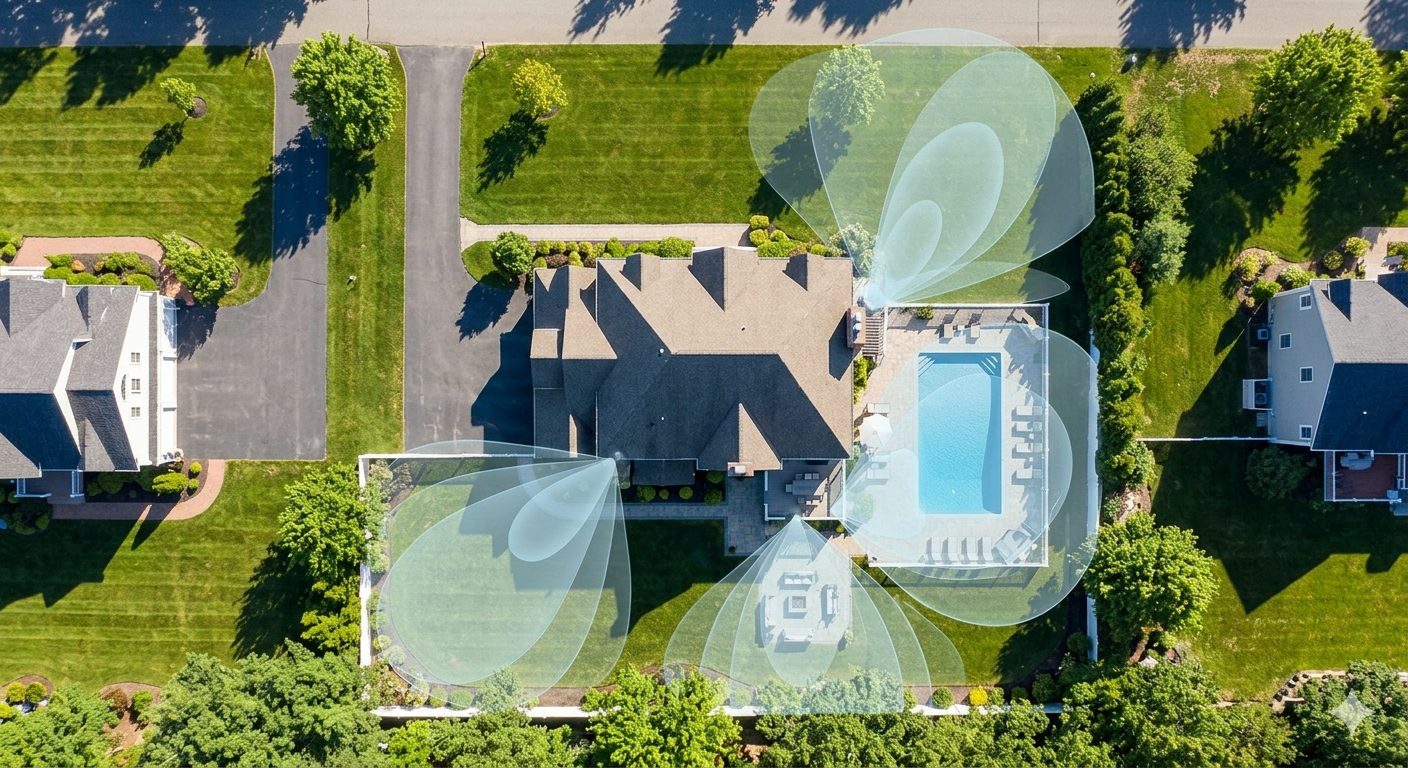
That has changed. Ground-coupled bass vaults, photogrammetric mineral shells cast from real stone, beam-steering arrays, and adaptive DSP have moved the performance ceiling from "patio gimmick" to genuinely architectural. We cover the physics in a companion piece, The physics of burying a subwoofer.

Signal three: the channel is already built

Here's what makes 2026 different from a typical emerging technology: the distribution network already exists. The same integrators who scaled shades and lighting own the client relationships, the single-app ecosystems, and the install crews. A new outdoor zone is a software addition to a system the client already lives in — not a new vendor, app, or remote.

Signal four: the story sells itself

"Designed to disappear" is one of the most reliable messages in luxury technology. It carried the invisible in-wall speaker movement onto award shelves and into the design press. Landscape audio inherits that narrative wholesale: full-property sound, zero visual footprint, the designer's vision untouched.

The conclusion

We're not arguing that rock speakers are good because they used to be popular. We're arguing the opposite — that the category was never given a real attempt, the demand never went away, and the exact conditions that turned shades and lighting into expectations are now present in outdoor audio for the first time. 2026 is the year the last objection disappears.

Read the full 2026 forecast →

Engineering

The physics of burying a subwoofer

The single biggest objection to outdoor audio has always been bass. To move enough air outdoors — with no walls, ceiling, or room gain to help — you traditionally need a large, visible box. That box is exactly what homeowners and designers refuse to put in a beautiful landscape. Geo-acoustic design solves this by doing something that sounds counterintuitive: it puts the subwoofer underground.

Why outdoor bass is hard

Indoors, a subwoofer gets help. Room boundaries reinforce low frequencies (we call it room gain), and the enclosed volume lets modest drivers feel powerful. Step outside and all of that disappears. Sound radiates into effectively infinite space, low frequencies roll off fast, and the only brute-force answer is more cone area and more enclosure volume — i.e., a bigger visible box.

The earth as an enclosure

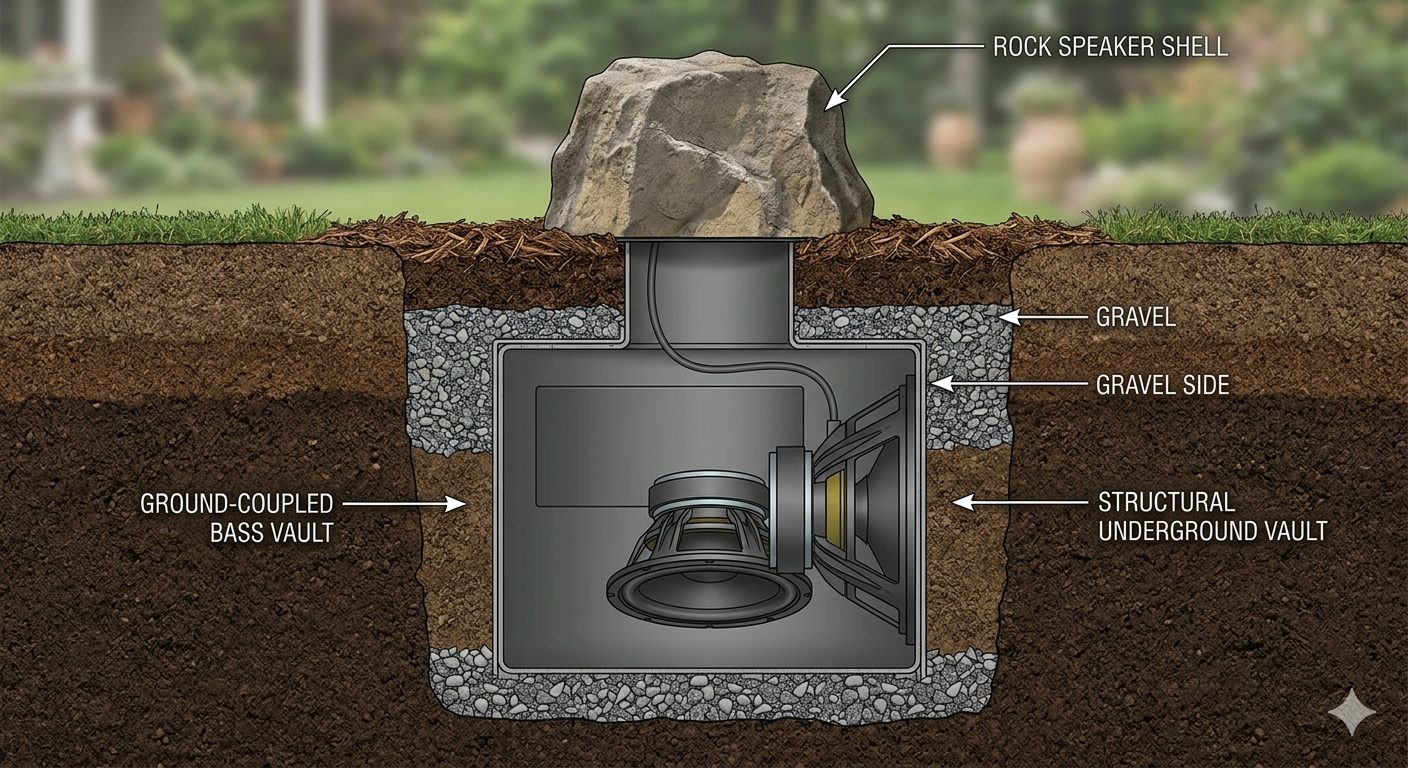
A ground-coupled vault flips the problem. The woofer fires into a sealed composite enclosure set below the frost line, and the surrounding soil mass acts as a near-infinite baffle. Instead of fighting the open environment, the design recruits the ground itself as part of the acoustic system. The result is clean, extended low-frequency output — we target usable response to 28 Hz — with no visible hardware whatsoever.

Frost line Soil mass = near-infinite baffle Surrounding earth loads the driver and damps resonance
Simplified ground-coupling principle: the woofer fires into a sealed sub-grade vault loaded by the surrounding soil.

It's not only louder — it's cleaner

Burying the driver does more than hide it. The soil mass provides mechanical damping that a free-standing outdoor box can't match, reducing the boomy, one-note character that plagues conventional patio subs. Bass becomes tight and tactile — you feel it through the hardscape rather than hearing it rattle a plastic housing.

Surfacing the sound evenly

A tuned waveguide couples the vault to the area around the mineral shell so low frequencies emerge uniformly rather than from a single point. Combined with the beam-steering mid/high array in the shell above, the system delivers full-range sound that appears to come from the landscape itself — not from a speaker sitting on it.

Engineering the shell

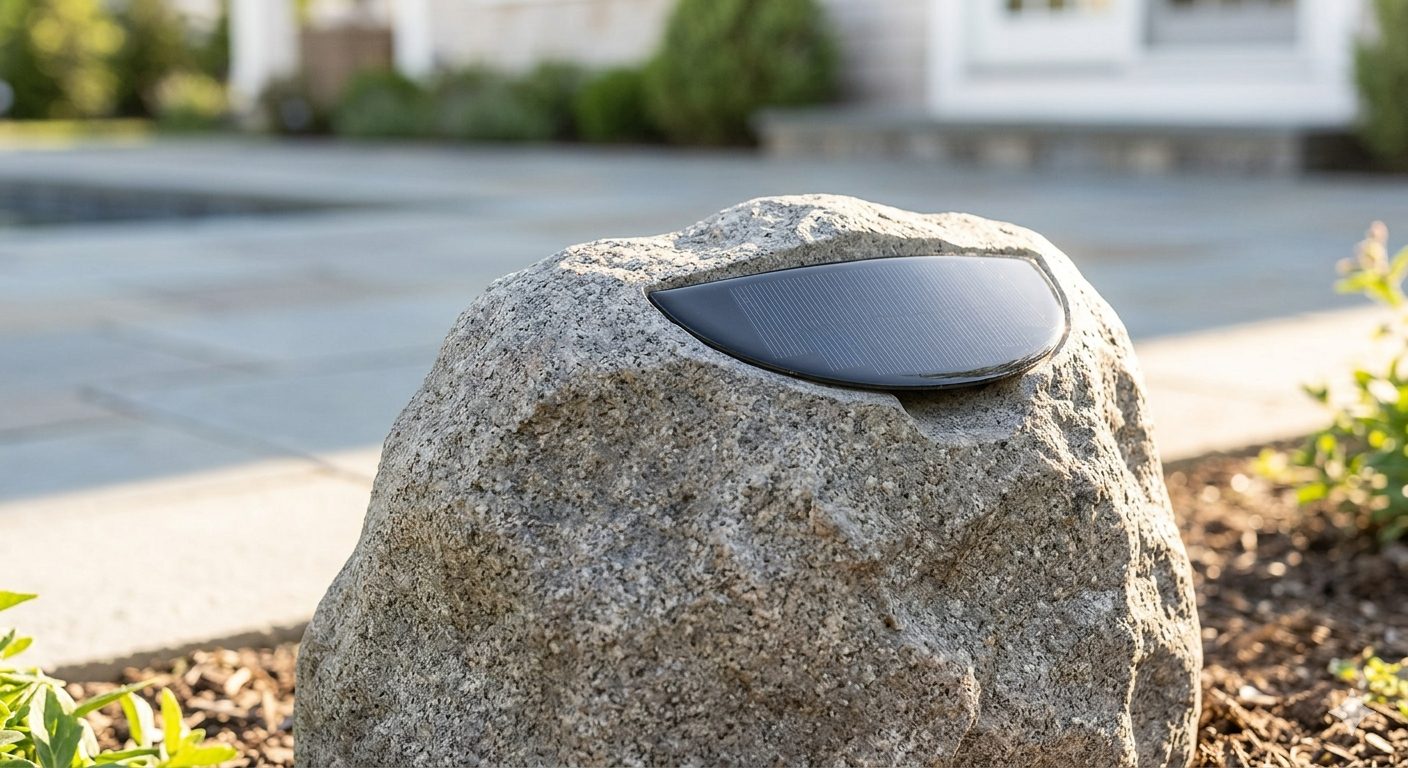
The visible element is a mineral-polymer composite shell, cast from a laser scan of real granite or basalt so it matches local stone. It's engineered to be acoustically transparent across the array's passband while surviving UV, freeze-thaw cycles, and decades outdoors. The hard part was never making a rock-shaped object — it was making one that's also a precision acoustic device.

The takeaway

"Bury the subwoofer" sounds like a party trick until you work the physics. Ground-coupling turns outdoor audio's hardest constraint — bass with no box — into a strength, and it does so while erasing the visual footprint that killed the category the first time around.

See the full platform architecture →

Design

Designed to disappear: lessons from the award shelf

In 2024, Boston Automations was recognized with the Sonance + James Loudspeaker "Designed to Disappear" Project of the Year. The award celebrates a specific philosophy: the best technology in a luxury home is the technology you never see. That idea is also the most reliable predictor we have of which categories break out — and it's the heart of the case for geo-acoustic outdoor audio.

The designer is the gatekeeper

In the projects that matter most, the interior designer or architect holds veto power over anything that touches a sightline. We've watched beautiful audio plans get cut not because the client didn't want sound, but because a designer wouldn't accept visible boxes on a wall or in a garden bed. The category that wins the designer's trust wins the project.

Every visible speaker is a negotiation with the designer. An invisible one is a gift.

Invisibility is a feature, not a compromise

The invisible in-wall speaker movement proved that homeowners will pay a premium specifically for the absence of hardware. Plaster-over speakers don't outperform high-end visible models on raw specs — they win because they vanish. That willingness to pay for disappearance is the commercial engine behind the entire architectural audio segment.

Geo-acoustic outdoor audio applies the same logic outside. The homeowner gets full-property sound; the designer gets a landscape with no speakers in it. Both sides get what they actually wanted, and neither has to compromise.

Why landscape is the perfect canvas

Indoors, "invisible" means hiding hardware in walls and ceilings. Outdoors, nature does the work for you. A mineral shell cast from local stone doesn't just hide a speaker — it reads as something that belongs in the garden. There's no awkward grille, no plastic dome perched on a deck rail, no compromise between the audio plan and the planting plan.

The lesson for 2026

When we look at why shades, lighting, and now power each crossed over, the design narrative was never an afterthought — it was the accelerant. "Designed to disappear" turned invisible speakers into an award category and a profit center. Outdoor audio is the next place that story applies, and the technology has finally caught up to the promise.

Read the 2026 forecast →  ·  Explore the technology →

Stay ahead

Want the category before your clients ask for it?

Book a briefing with Boston Automations.

Read the forecast Book a briefing